
95% of Churches Don’t Have a Disciple-Making Culture — Does Yours?

Dear Discipleship-First Friends,
Most pastors I know genuinely want to make disciples. They preach faithfully, they baptize new believers, they launch small groups and ministries. Their calendars are full. Their churches are active. And yet somewhere beneath all that activity, a quiet question keeps surfacing:
Are we actually making disciples who make disciples—or are we just keeping people busy?
A few years ago, we set out to answer that question with data. Discipleship.org partnered with Exponential and Grey Matter Research to conduct one of the most extensive studies ever done on disciple making cultures in evangelical churches across the United States. They interviewed one thousand senior pastors across denominations, regions, and church sizes.
What they found should alarm every church leader in North America.
Just under 5% of churches had cultures rooted in Jesus-style disciple making.
That means 95% of our churches—filled with sincere followers of Jesus—do not have a culture of disciple making.
The Five Levels
To understand what’s really happening, it helps to think about churches on a spectrum. The research identified five levels:
Level 1 — Subtracting (29% of U.S. churches): These churches are declining, losing people year over year.
Level 2 — Plateauing (44% of U.S. churches): These churches have flatlined — not losing, not growing.
Level 3 — Adding (27% of U.S. churches): These churches are growing — but by attraction, not reproduction. Compelling preaching, great worship, strong programs. Good things. But they produce consumers, not disciple makers.
Level 4 — Reproducing (less than 5%): A small but meaningful group of churches where disciples are actually being made and multiplication is taking root.
Level 5 — Multiplying: Churches where disciple making isn’t a ministry of the church — it’s the culture of the church. Disciples making disciples, leaders raising up leaders, groups reproducing groups, churches planting churches.
Here’s what stopped us cold when we published this research back in 2020: we couldn’t find a single Level 5 church in the United States.
Not one.
A Lesson from India
I know the difference between addition and multiplication firsthand — because I had to learn it the hard way.
When I arrived in India as a missionary, our small team gathered to pray about reaching 1.3 billion people with the gospel. There were eight of us. Eight people. 1.3 billion lost souls. One team member said, “What if we could reach 100,000 people a year? Wouldn’t that be incredible?” I pulled out my calculator. At that rate, it would take 13,000 years. Even reaching a million people a year, it would still take 1,300 years — just to reach India alone.
Addition was never going to get the job done.
We got on our knees and asked God to show us a different path. He led us to the story of Ying Kai and his wife Grace in South China, who intentionally shifted from adding attendees to multiplying disciples. Over ten years, more than 200,000 churches were started and over a million people were baptized.
So, we made the same shift. In 2015, we started living out these principles by planting eight little house churches. Since then, we’ve planted over 50,000 churches and seen more than 300,000 people come to faith. That isn’t human effort. It’s all God and the power of multiplication.
What God is doing in India isn’t limited to India. It’s so exciting to see these same principles start to take hold in some churches in America.
The Search for Level 5 Churches
That’s what drove us to go looking again in 2025. As questions poured in from church leaders across the continent—Where are the churches actually doing this? Does it even exist in America?—we set out to find them.
We reached out to more than 100 denominations and networks. We interviewed hundreds of leaders. We sifted through data, asked practitioners to name the churches where multiplication wasn’t a motto but a reality and listened to stories of both heartbreak and hope.
And we found them.
Level 5 churches exist in North America. They’re spread across regions, denominations, sizes, and styles. Some are large; many are small. Most don’t advertise themselves. They were simply obeying Jesus in simple, reproducible ways—and the fruit was unmistakable.
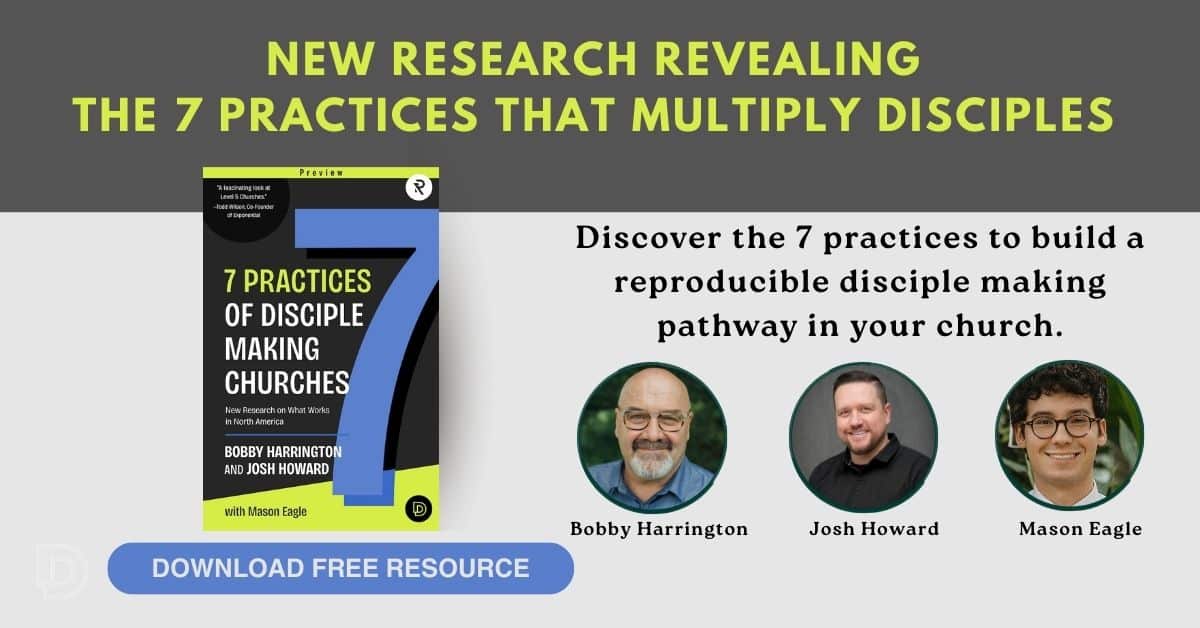
What they share isn’t a method or a model. It’s a culture. And that culture is built on seven shared principles that show up in every one of these multiplying churches, regardless of where they’re located or what they look like.
A pastor in Georgia whose simple obedience-based model has now spread to Sweden and Mongolia. A decentralized micro-church network in Florida mobilizing ordinary believers into dozens of everyday mission fields. A college-town church where students plant churches before they graduate. A nurse in Atlanta who took a ten-week model and launched a disciple-making movement inside her hospital.
These stories aren’t outliers. They’re signs. Signals that multiplication is not only possible—it’s already happening.
The Question Every Leader Has to Answer
The research question we asked in 2020 was whether Level 5 churches existed in America. We couldn’t find them. By 2025, we found them.
The question now isn’t whether multiplication can happen in North America. It already is. The real question — the one every pastor, elder, and church leader must wrestle with — is this: Will we become the kind of church where it can happen?
If you’re asking that question, this book is for you. It’s for the pastor who’s tired of shallow metrics. For the church planter who refuses to settle for a crowd. For the elder who knows something fundamental is missing. For every leader who’s ever stared at a full calendar and an empty soul and asked: Is there a better way?
There is. And we found the churches proving it.
On mission with you,


If you have enjoyed reading this, please consider joining our email list!


